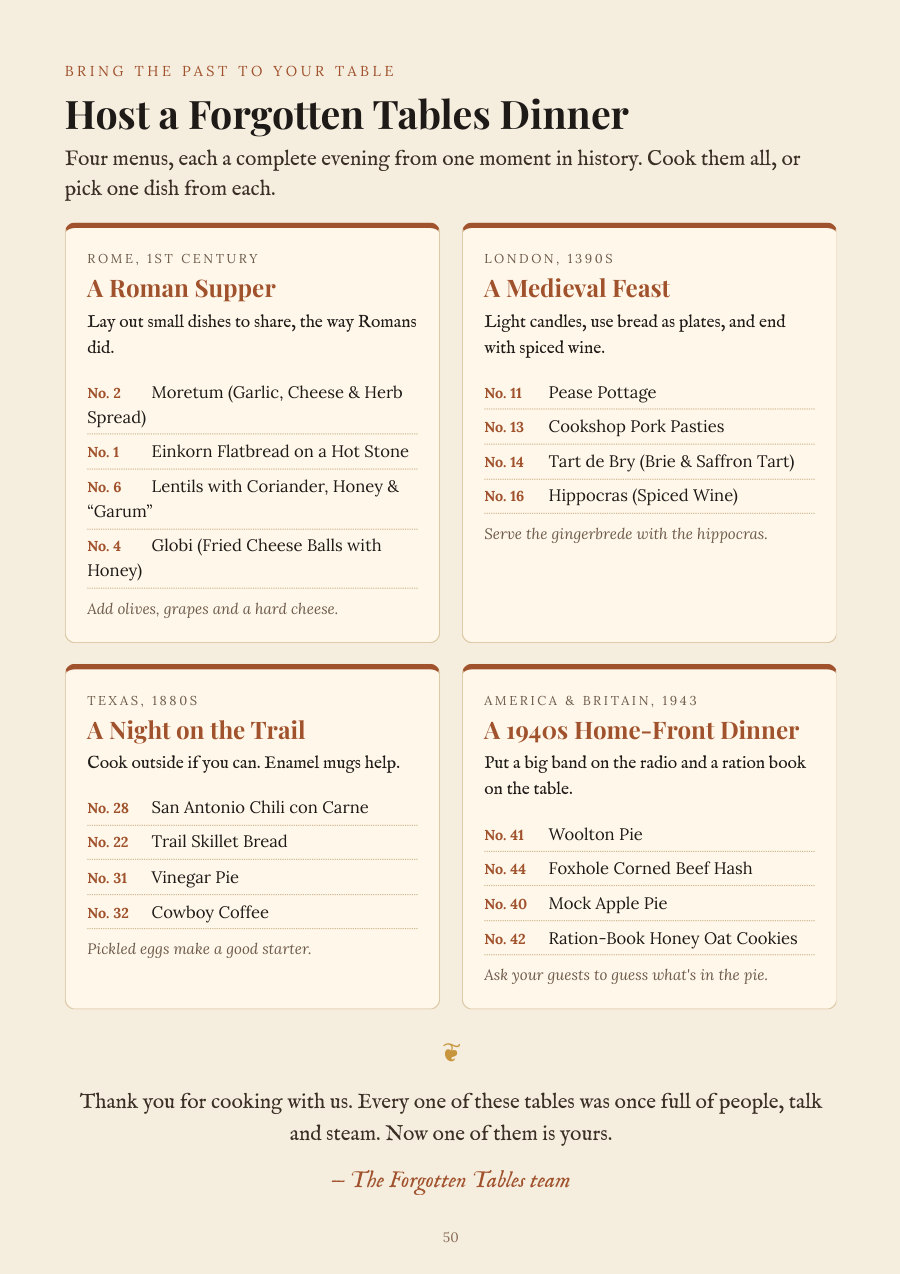
44 recipes from Roman markets, Viking longhouses, medieval taverns, Wild West chuckwagons and wartime kitchens, each one rewritten for the kitchen you have today.

Not what kings ate at coronations, but what ordinary people ate on an ordinary day.
A farmer near Rome pounding garlic and cheese before dawn. A family on the Oregon Trail baking bread in a skillet over a fire of buffalo chips. A woman in Ohio in 1943, trying to make a birthday cake with half the sugar she used to have.
After every video, the comments ask the same thing: can we actually cook this? So we went back to the old cookbooks, soldiers' memoirs, ship's menus, wartime leaflets and archaeologists' reports, and we chose 44 dishes that tell the story of a time and a place, and that still taste good today.
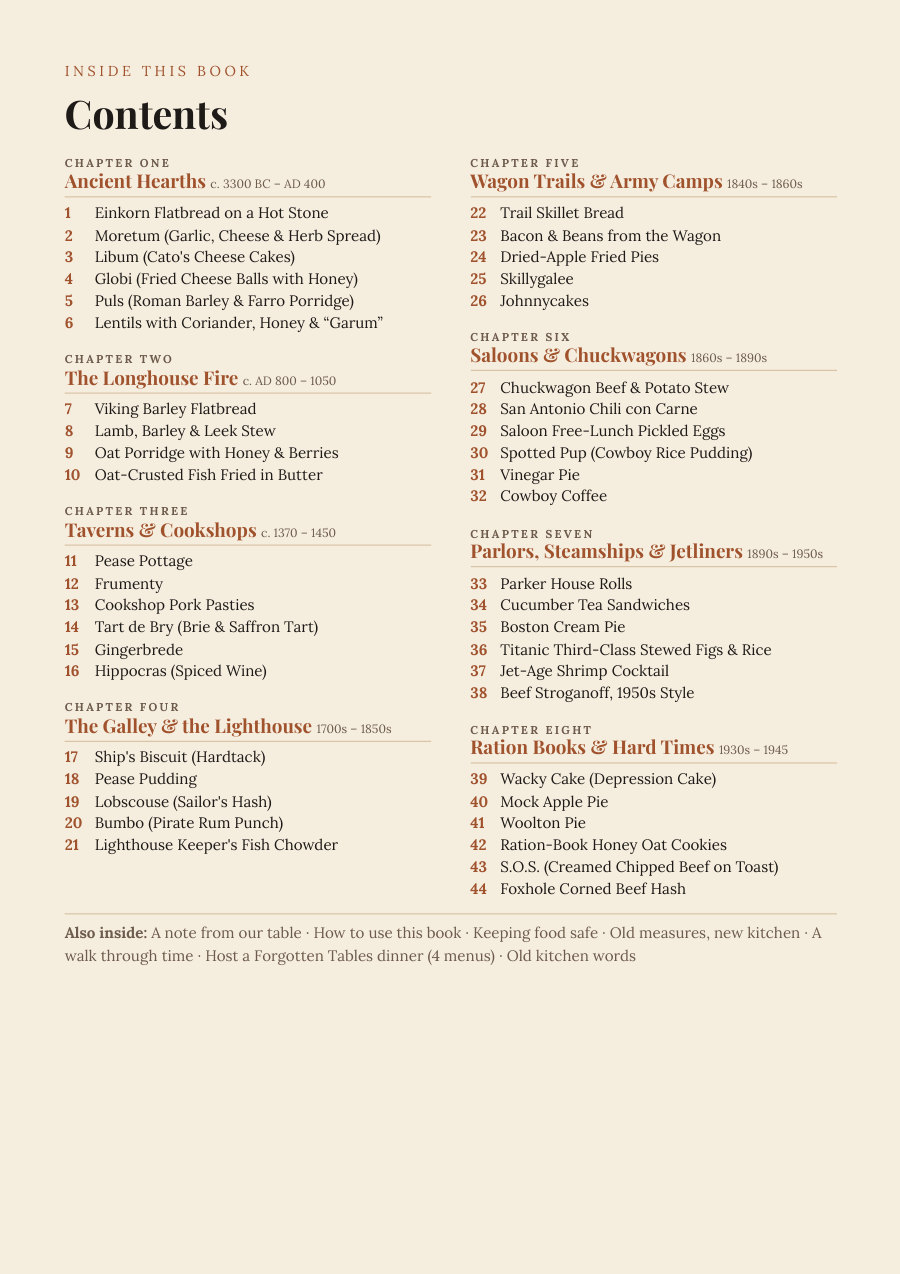
The Iceman's einkorn bread, Cato's honey cakes, Roman lentils with “garum”.
Barley flatbread, lamb and leek stew, and fish fried in butter on a Norwegian fjord.
London pasties, frumenty from the King's own recipe roll, and spiced hippocras.
Ship's biscuit, sailor's lobscouse, pirate bumbo and a Maine keeper's chowder.
Skillet bread on the Platte River, wagon beans, and the soldiers' skillygalee.
Chuckwagon stew, San Antonio chili, saloon pickled eggs and cowboy coffee.
Parker House rolls, the Titanic's third-class tea, and 1959 shrimp cocktail.
Wacky cake, mock apple pie, Woolton pie and a foxhole corned-beef hash.


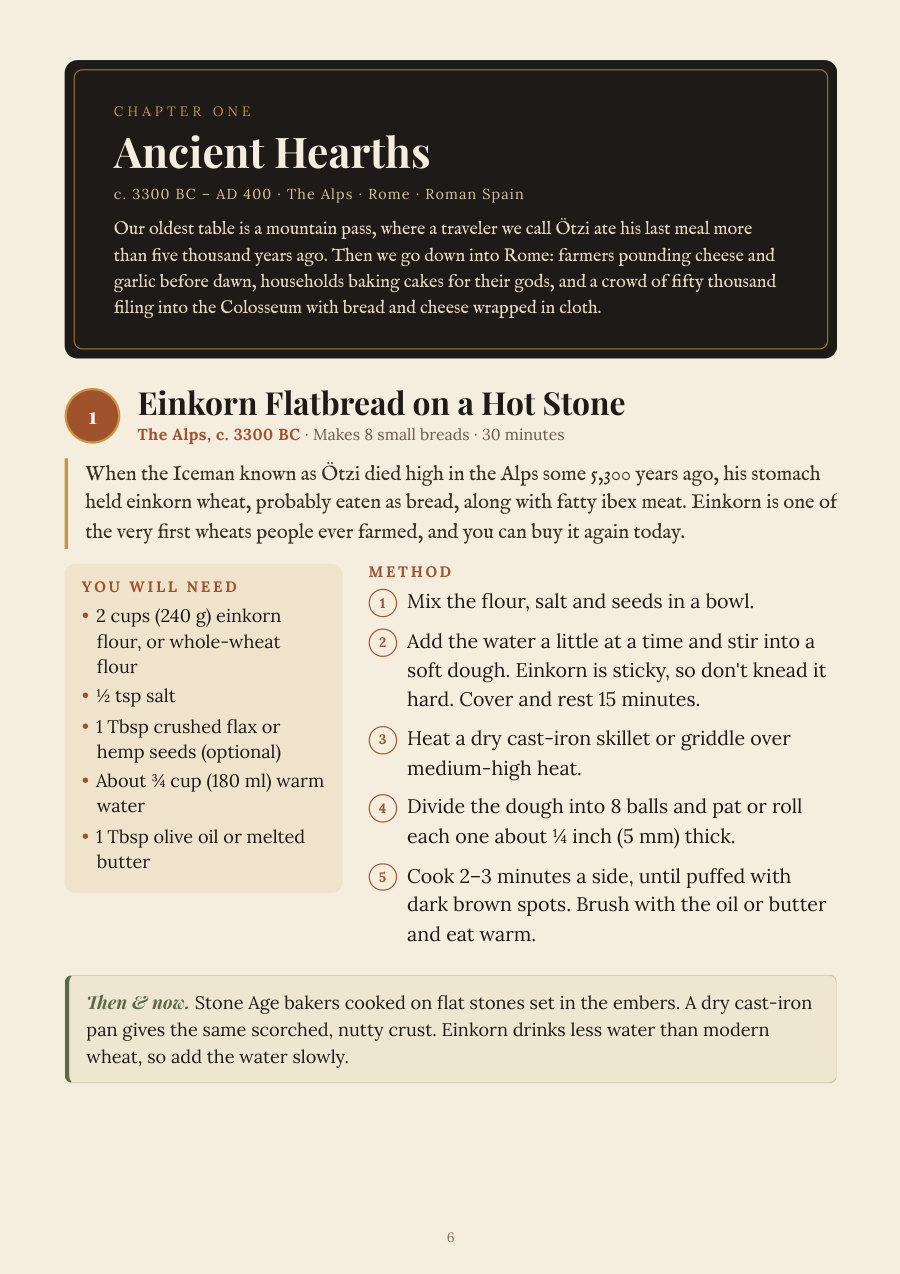
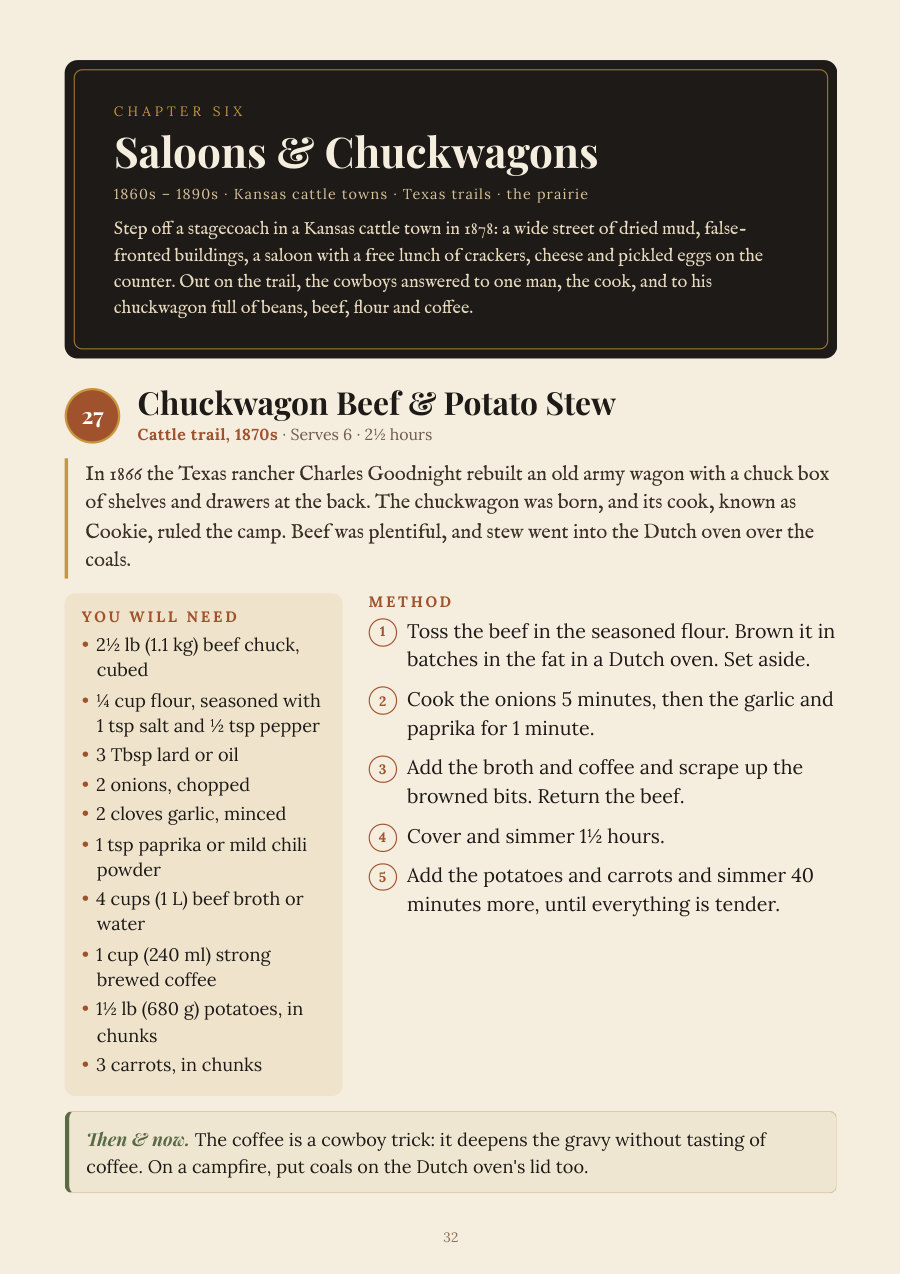
Who ate it, where, and why, in a few honest lines.
Supermarket ingredients, in cups and grams.
Numbered, tested-style instructions for a normal stove and oven.
How they cooked it then, and the shortcut we use now.
Cato the Elder wrote this recipe down in his farming manual, On Agriculture: cheese, flour and a single egg, baked on bay leaves. Libum was offered to the household gods and baked for birthdays.
That's 1 of 44. Get the other 43 →
Open the book, bake the libum, try the chili. If it isn't for you, ask for a refund within 7 days of purchase and you get every cent back. No questions, no hard feelings.
Right after payment you get access to a download page. The PDF opens on any phone, tablet or computer, and prints well on A4 or US Letter paper.
No. Every recipe uses ingredients from a normal supermarket. Where the original used something rare or unsafe (Roman garum, the herb rue, raw eggs), we tell you what we swapped and why.
They are summarized from historical cookbooks, memoirs, menus and archaeology. When a story is a tradition rather than a documented fact, the book says so.
Most are simple home cooking: stews, breads, porridges, pies. Steps are numbered and written for a modern stove and oven, with safe cooking temperatures.
It's a digital PDF, so you get it instantly and can print any page you like for the kitchen counter.
You're covered by a 7-day money-back guarantee. Just request a refund within 7 days.
What people really ate, and how they really lived.
Cato's 2,000-year-old cheese cakes are on this page, free. And if you want the other 43, the cookbook is $9.90 at launch.
Show me the free recipe